Clear vision plays an essential role in daily life, from reading and working on screens to driving and enjoying outdoor activities.
However, vision problems like nearsightedness and farsightedness affect millions of people worldwide.
Many individuals depend on glasses or contact lenses to see clearly. Fortunately, modern eye care has introduced advanced solutions such as LASIK surgery that can correct these issues effectively.
LASIK is one of the most commonly performed vision correction procedures today. If you have ever searched for an eye hospital near me, eye clinic near me, or eye doctor near me to explore permanent vision correction options, LASIK surgery may already be on your radar.
Visualeyes Hospital in Ujjain provides advanced LASIK treatments designed to correct refractive errors and improve visual clarity.
This article explains how LASIK surgery works, how it corrects nearsightedness and farsightedness, and what patients can expect before and after the procedure.
Understanding Nearsightedness and Farsightedness
Before exploring LASIK surgery, it is important to understand the two common vision problems it treats.
Nearsightedness (Myopia)
Nearsightedness occurs when distant objects appear blurry while nearby objects remain clear.
This condition develops when the eyeball is slightly longer than normal or when the cornea curves too much. As a result, light focuses in front of the retina instead of directly on it.
Common symptoms include:
- Difficulty seeing distant objects clearly
- Squinting while reading road signs
- Eye strain during daily activities
- Frequent headaches
Farsightedness (Hyperopia)
Farsightedness is the opposite condition. People with hyperopia can see distant objects clearly but struggle to focus on nearby objects.
This happens when the eyeball is shorter than normal or when the cornea is too flat.
Common symptoms include:
- Blurred vision during reading
- Eye fatigue while using digital devices
- Difficulty focusing on close objects
- Headaches after prolonged screen time
LASIK surgery helps correct both conditions by reshaping the cornea so that light focuses properly on the retina.
What is LASIK Surgery?
LASIK stands for Laser-Assisted In Situ Keratomileusis. It is a laser-based procedure used to correct refractive vision errors such as:
- Nearsightedness (myopia)
- Farsightedness (hyperopia)
- Astigmatism
During the procedure, a specialized laser reshapes the cornea, which is the transparent front part of the eye.
This reforming allows light entering the eye to focus correctly on the retina, improving vision without the need for glasses or contact lenses.
Many people searching for an eye clinic near me consider LASIK because the procedure is quick, minimally invasive, and has a fast recovery period.
Note: If LASIK is not the right option for your condition, other specialized treatments may be recommended. For patients dealing with eye alignment problems, we also offer advanced squint eye surgery performed by experienced specialists.
How LASIK Corrects Nearsightedness
When someone has myopia, the cornea bends light too strongly. This causes light rays to focus before reaching the retina.
LASIK corrects this by flattening the cornea slightly.
How the correction works
- The surgeon creates a thin flap in the cornea.
- A laser removes microscopic layers of corneal tissue.
- The cornea becomes flatter.
- Light rays now focus directly on the retina.
Once the cornea is reshaped, distant objects appear much clearer. This is why LASIK is highly effective for people who struggle to see objects far away.
Patients visiting Visualeyes Hospital in Ujjain often seek LASIK treatment to reduce their dependence on glasses for distance vision.
How LASIK Corrects Farsightedness
In farsightedness, the cornea does not bend light enough. This causes light to focus behind the retina instead of on it.
LASIK corrects this by increasing the curvature of the cornea.
Steps involved in correction
- A thin flap is created in the cornea.
- The laser removes tissue in a way that steepens the cornea.
- The cornea can now bend light more effectively.
- Light rays focus correctly on the retina.
After the procedure, patients can see nearby objects more clearly without needing corrective lenses.
What Happens During LASIK Surgery
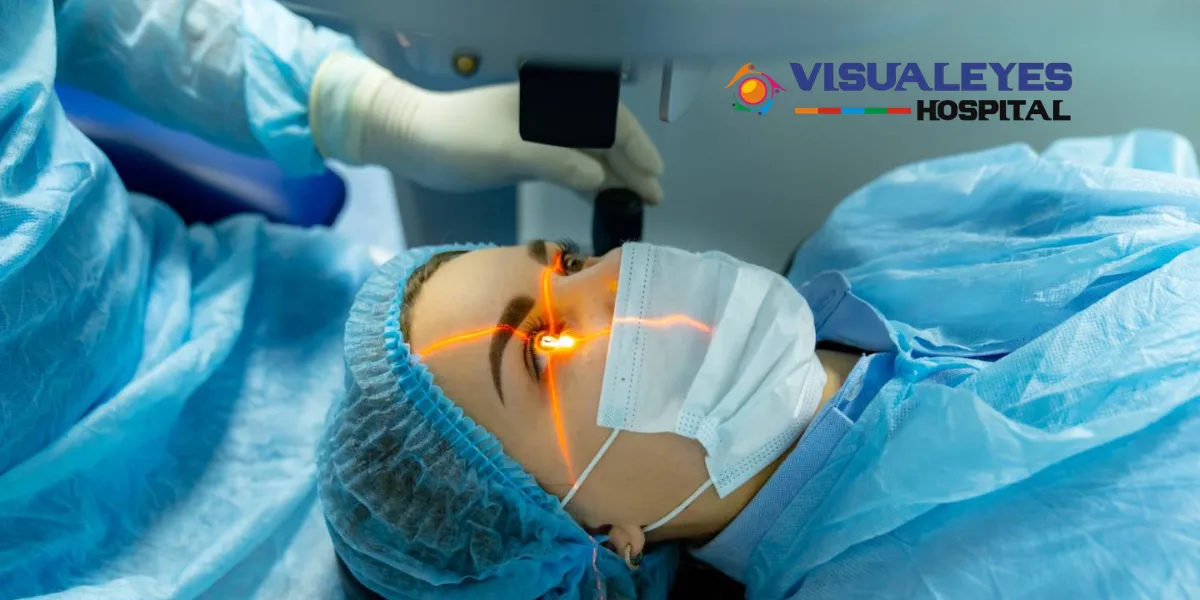
LASIK surgery is usually completed within 15 to 20 minutes for both eyes. The procedure is painless because numbing eye drops are used.
Typical LASIK procedure steps
- The eye is numbed using anesthetic drops
- A small corneal flap is created
- A precision laser reshapes the cornea
- The flap is repositioned naturally
The cornea begins healing almost immediately after surgery.
People often search for an eye doctor near me when considering LASIK because the success of the procedure depends heavily on the expertise of the surgeon and the technology used.
Benefits of LASIK Surgery
LASIK has become one of the most preferred vision correction treatments due to its benefits.
Key advantages include
- Reduced dependence on glasses or contact lenses
- Fast procedure with minimal discomfort
- Quick visual recovery
- Long-lasting results
- Improved quality of life
Most patients notice improved vision within 24 hours after the surgery.
Who is a Good Candidate for LASIK?
Not everyone is suitable for LASIK surgery. Eye specialists conduct a detailed eye examination before recommending the procedure.
You may be a good candidate if:
- You are above 18 years of age
- Your vision prescription is stable
- Your cornea is healthy and thick enough
- You do not have severe eye conditions
A consultation with an experienced eye specialist helps determine whether LASIK is the right option for you.
Note: If visiting the clinic is difficult, you can also opt for our home eye checkup service, where trained professionals conduct basic vision assessments and guide you on the next steps for treatment.
Recovery After LASIK Surgery
Recovery from LASIK is typically quick compared to other surgical procedures.
Post-surgery care tips
- Avoid rubbing your eyes
- Use prescribed eye drops regularly
- Wear protective eye shields while sleeping
- Limit screen exposure for a few days
- Attend follow-up appointments
Most patients can return to work and normal activities within a short period.
Why Choosing the Right Eye Hospital is Important
The outcome of LASIK surgery depends significantly on the experience of the medical team and the quality of technology used.
When searching online for an eye hospital near me, it is important to look for a hospital that offers advanced diagnostic tools, experienced surgeons, and comprehensive post-operative care.
Visualeyes Hospital in Ujjain provides modern eye care services, including LASIK vision correction procedures designed to help patients achieve clearer and sharper vision safely.
Conclusion
LASIK surgery has transformed the way vision problems such as nearsightedness and farsightedness are treated.
By reshaping the cornea with advanced laser technology, LASIK helps light focus correctly on the retina, restoring clear vision and reducing reliance on glasses or contact lenses.
For individuals exploring permanent vision correction solutions, consulting an experienced eye specialist is the first step toward better vision.
If you are considering LASIK and searching for a trusted eye clinic near me, Visualeyes Hospital in Ujjain offers advanced eye care solutions with modern technology and expert guidance to help patients achieve improved visual clarity.
Book Your LASIK Consultation Today
Clear vision can transform your daily life. If you are tired of relying on glasses or contact lenses, LASIK surgery could be the solution you are looking for.
Schedule your consultation today and take the first step toward sharper, clearer vision.
Yes, LASIK surgery provides long-lasting vision correction by reshaping the cornea. While natural aging may still affect eyesight later in life, most people experience permanent improvement in vision after the procedure.
LASIK surgery is generally painless. Doctors use numbing eye drops during the procedure, and most patients feel only mild pressure for a few seconds.
Many patients notice improved vision within 24 hours. Complete healing usually takes a few weeks, but most people can resume normal activities within a few days.
Yes, LASIK surgery is typically performed on both eyes during the same session. The entire procedure usually takes less than 20 minutes.
LASIK is usually recommended for individuals who are at least 18 years old and have a stable vision prescription for at least one year. An eye examination helps determine eligibility.